

What is Data Encryption Standard (DES)? A Complete Guide
The adoption of the internet has resulted in a continuous flow of information across the web.
From email, calls, transactions or shopping, everything is done online. If a user wants to do any of these things, they can do it remotely just with a smartphone or laptop.
Now, in order to protect the user information, what must one do? This is where encryption has been the most important thing when it comes to protecting user data. But to understand modern encryption, you need to know about the Data Encryption Standard (DES).
In this blog, you will learn everything about the Data Encryption Standard.
What Is the Data Encryption Standard?
A data encryption standard is a method used for encrypting data. Encryption means taking the readable data and converting it into an unreadable form (ciphertext). This unreadable data is generated by using algorithms to convert the plain text into secret codes.
DES was created by IBM in the early 1970s and was then later adopted by the U.S. government in 1977. It became the official standard for protecting government data. Sooner, banks and private companies around the world also adopted it, and it became a go-to method for improving their database security with encryption.
A Brief History of the Data Encryption Standard
Where Did DES Come From?
DES’s origin story is quite interesting. In the early 1970s, the U.S. National Bureau of Standards (NIST) was willing to find out a reliable way to protect government data. In response to this, IBM came up with a cipher called “Lucifer”, which they had been developing since the late 1960s.
The National Security Agency (NSA) then added some modifications to Lucifer, which is now known as DES. It was officially adopted in 1977.
Why Was DES Important?
Before the introduction of DES, different encryption methods were used by different organizations. There was no single standard that was completely agreed upon, making the communication between systems difficult and insecure.
DES helps solve this problem and provides everyone a common data encryption system. It was considered a major event in the cybersecurity space.
When Did DES Fall Out of Use?
By the late 1990s, a big problem occurred. The computers have become capable of cracking DES. Following 1999, a team of researchers was known to be able to break the DES in less than 24 hours. This was a shocking result and provided that DES was no longer safe.
In 2001, the U.S. government replaced the DES with AES, which stands for Advanced Encryption Standard. But the DES is still studied today because it is the foundation of modern encryption methods.
How Does the Data Encryption Standard Work?
The Basics of DES
DES is a symmetric-key algorithm. It means encryption and decryption are done with the same key. In the context of real life, the sender and receiver both need to have the same key. Data encryption in DES is done in blocks that are 64 bits long. Let’s say if your message is longer than 64 bits, DES will divide it into multiple blocks and encrypt them separately.
The Role of the Key
This encryption key is 56 bits long in DES. It means that there are over 72 quadrillion possible combinations. This might sound like a lot, but modern computers can quickly go through all these combinations.
Key Management in DES
Since DES is a symmetric key algorithm, the keys used to be physically delivered to the sender or receiver through trusted sources. This made the process slow and highly prone to errors.
This pushed the cybersecurity industry to use a dedicated key management system that uses automated protocols to electronically share the encryption keys. Not only distribution, but also automation of the entire lifecycle of the cryptographic keys.
The 16 Rounds of DES
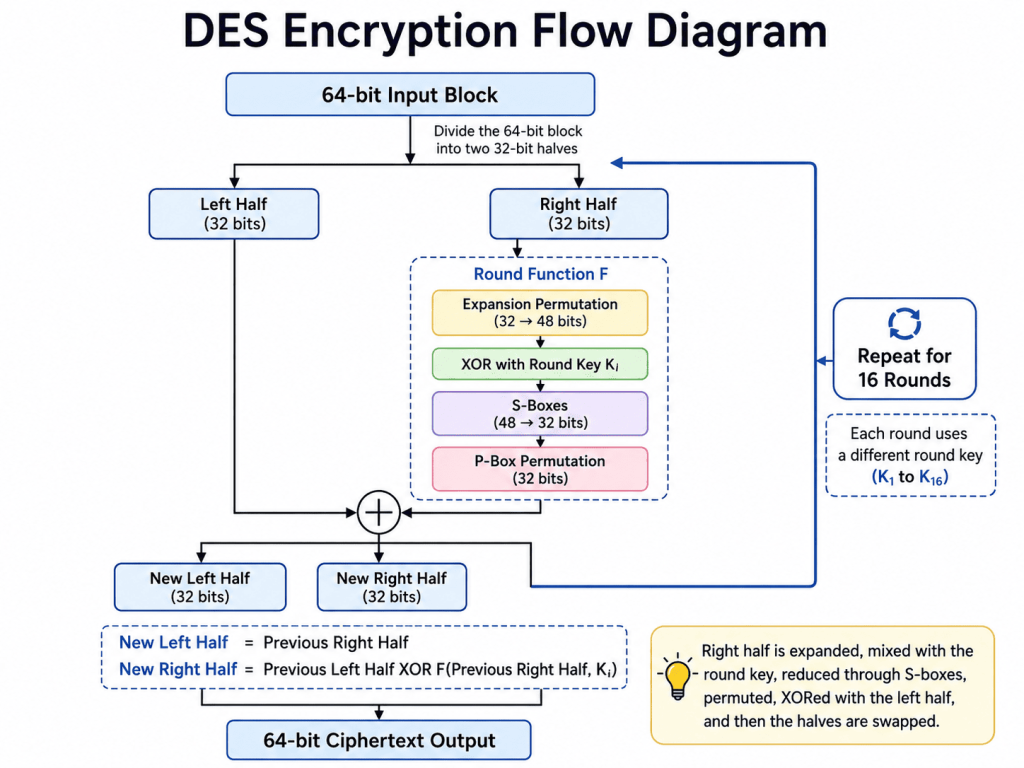
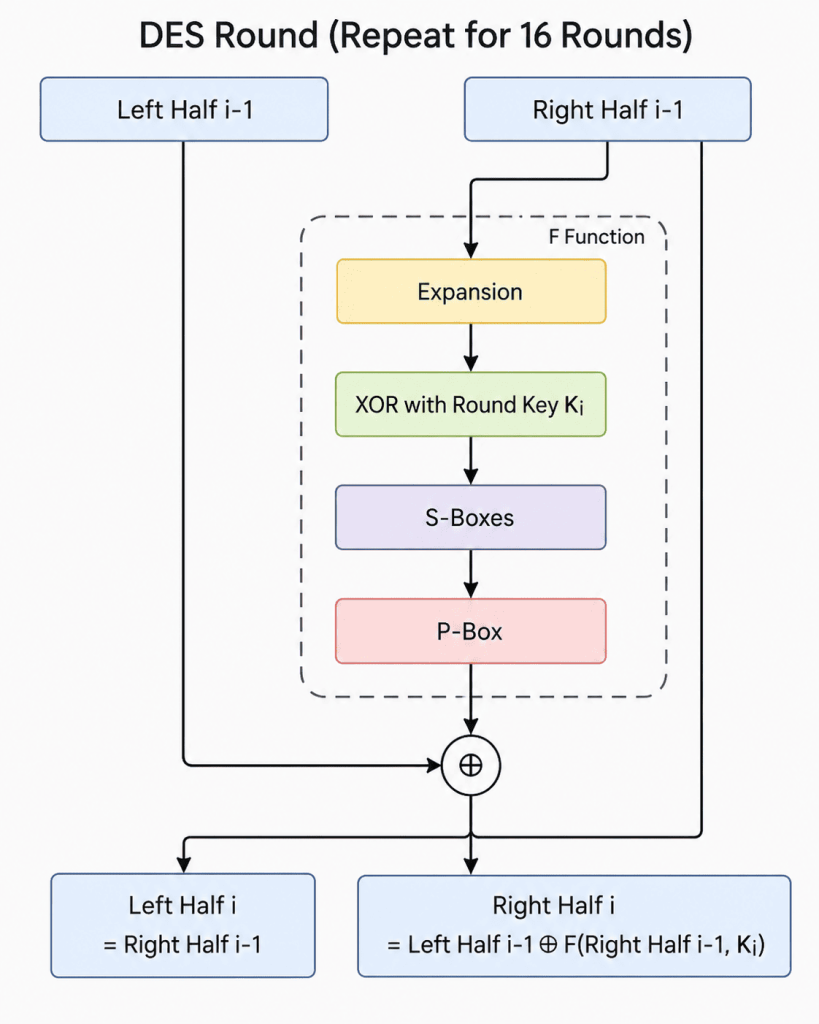
The DES doesn’t shuffle your data once. It shuffles it 16 times. Each of these shuffles of data is called a “round”.
Here’s what happens:
- The 64-bit block that contains your data is divided into two halves—right and left.
- The right half goes through an expansion permutation that can be in the range of 32-48 bits.
- The result passes through S-boxes, which substitute the data to reduce it back to 32 bits
- The output then goes through a P-box, which rearranges the 32 bits in a fixed pattern
- The final output is XORed with the left half and the two halves are swapped
- This process repeats 16 times, each time using a different version of the key
This repetition of blocks keeps the encrypted data safe and makes it difficult to decode without the correct version of the key.
Feistel Network
DES uses the structure of a Feistel network, which was designed by Horst Feistel at IBM. The Feistel network is a convenient structure that can be used for both encryption and description. All you need to do is to reverse the order of the key version being used in each round. Even the modern encryption algorithms used today are based on the Feistel network design.
The Strengths of the Data Encryption Standard
Even though DES is an outdated concept, it still had real strengths when it was introduced.
First Widely Accepted Standard
DES was the first ever to give the world a common language for data encryption. Before DES, there was no universal standard that could have made the communication secure.
Open and Transparent
The algorithm that DES uses was shared with the public. This helped experts around the world to study and test it.
Efficient Encryption
DES was fast enough for the encryption process of that time. Also, it can be used in both hardware and software, making it reliable for different systems.
Inspired Modern Encryption
DES was the first ever standard that gave the knowledge of encryption to the world. It inspired the development of better algorithms. Many data encryption solutions are still built on the basic roots of DES.
The Weaknesses of the Data Encryption Standard
Short Key Length
One of the most obvious weaknesses of DES is its only 56-bit key. While in the past this was considered safe, modern computers today can easily get the right key combination by brute-force attack, which is one of the most common types of cyberattacks.
Furthermore, there was even a machine called “Deep Crack” that was specifically built to break DES. It has the capacity of testing 90 billion keys per second.
Vulnerability to Modern Attacks
Researchers identified that there are two ways to find the keys – differential cryptanalysis and linear cryptanalysis. It was then concluded that these two methods can find the keys much faster than trying every combination.
Not Suitable for Today’s Standards
Cybersecurity experts today suggest the keys have at least 128 bits. But the DES uses only 56 bits, which makes it unsuitable for protecting modern data.
Triple DES: An Attempt to Extend DES’s Life
What Is Triple DES?
When DES started to be outdated, a temporary solution was introduced. It was the Triple DES or TDEA (Triple Data Encryption Algorithm).
As the name suggests, Triple DES applies the DES algorithm three times to each block of data. It focused on increasing the length of keys and making it difficult to get the keys.
How Triple DES Works
Previously DES used a 56-bit key, but Triple DES uses either two or three different keys. Here’s how it looks:
- The data gets encrypted with a key.
- Then the data is decrypted with the key.
- At last, the decrypted data is again encrypted with the key.
This helps create an effective key length of 112 or 168 bits, which is far more secure than standard DES.
Is Triple DES Still Used?
Triple DES was used for years by banking and financial institutions for keeping their data safe. However, it became obsolete in 2023 and was officially disallowed by the NIST in 2023
DES vs. AES: What Replaced DES?
The Advanced Encryption Standard
After proving that the DES was insecure, the NIST held an open internal competition to find a replacement for it. Following these events in 2001, the Advanced Encryption Standard (AES) was selected.
AES uses key lengths of 128, 192 or 256 bits. This was even more secure than DES ever could be. Even with today’s modern computers, it takes billions of years to break the AES. Therefore, it is the world’s securest encryption.
AES is now used in everything from HSM, Wi-Fi security, and banking apps to government communications.
Conclusion
The Data Encryption Standard was a historical achievement for the foundational growth of cybersecurity. But the encryption process is continuously changing by using advanced algorithms like AES. It is much stronger and faster than DES, designed for the way we use technology.
Although DES is an old concept, it is the starting point of data encryption. Modern encryption today in all forms was possible because of the introduction of DES. Thus, DES has helped move beyond the old methods to create better encryption.
Frequently Asked Questions
1. What does the Data Encryption Standard do?
The Data Encryption Standard is the first-ever encryption method that converts readable data into secret code. It uses a 56-bit key and a process of 16 rounds to shuffle data so that only the user with the correct key can read it.
2. Is DES still used today?
No, DES is not used today. Due to its weak encryption, it was not considered suitable for modern use. It was officially replaced by AES in 2001.
3. What is the main weakness of DES?
The DES main weakness was that it used a 56-bit key to encrypt data. Modern computers can quickly try all the possible key combinations in a short amount of time. Thus, this made DES vulnerable to brute-force attacks.
4. What replaced the Data Encryption Standard?
The Advanced Encryption Standard (AES) replaced DES in 2001. AES uses key lengths of 128, 192 or 256 bits, longer than that of the 56 bits used in DES. This made it far more secure than DES.