

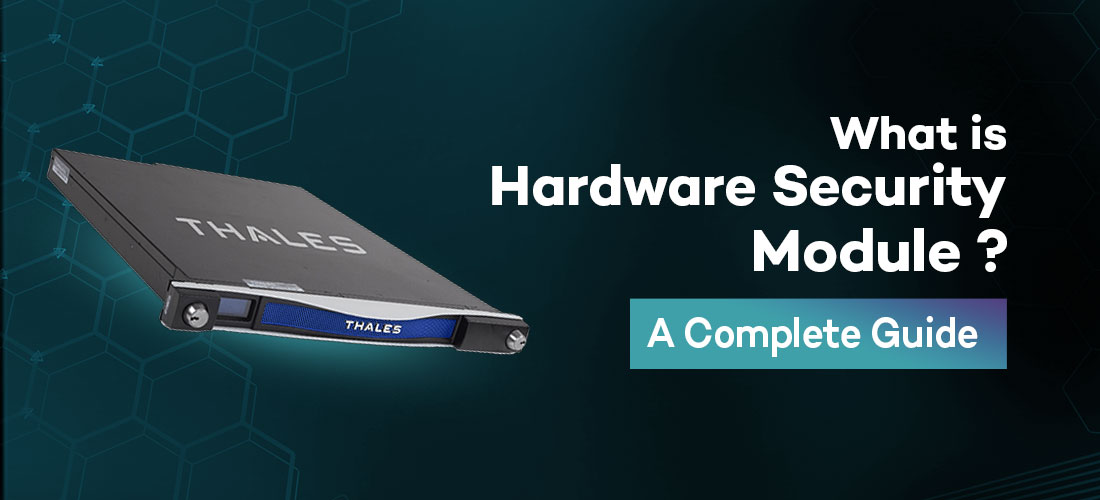
What is a Hardware Security Module (HSM)? A Complete Guide
Almost daily we can see multiple headlines of data breaches happening in organizations. Particularly, stealing personal and financial details of users is the priority target of attackers. Thus, businesses are finding it difficult to safeguard their customers’ digital data from these cybercriminals.
To address these problems, you can use an effective cybersecurity solution—a Hardware Security Module (HSM). In this blog, we will help you understand everything about the HSM: what it is, how it works, and why organizations should use it.
What is a Hardware Security Module?
A hardware security module (HSM) is a small physical device. It usually looks like a USB stick or a small box that can be connected to your computer devices or the server. It may sound like just an ordinary small device, but it is extremely powerful.
It is a device used by large enterprises to protect their cryptographic keys. These keys are special codes that are used to lock and unlock the encrypted data stored inside the digital keys. If someone steals these keys, they get access to the data stored inside the digital key. Therefore, the main purpose of using an HSM device is to protect your digital keys.
HSM Full Form
HSM stands for Hardware Security Module. Let’s break it down:
- Hardware: This means it is a physical device.
- Security: It protects important data
- Module: It’s a small plug-in unit that can connect with other systems
What Does an HSM Actually Do?
While a hardware security module is designed to do multiple tasks when protecting data, here are some main ones you must know:
- Generate cryptographic keys: It creates keys using a strong cryptographic algorithm.
- Store keys securely: Safely keeps the keys inside itself without exposing them.
- Perform encryption: Locks data to allow only the right person to read it.
- Perform decryption: Unlocks data for the right person with the correct key.
- Create digital signatures: Confirms that the data is real and has not been altered or deleted.
- Support authentication: Always checks if the user or the device is safe or not.
All the above-mentioned tasks take place inside the HSM. This means even if someone breaks into the computer systems, the keys will still remain safe inside the HSM.
Why is an HSM Important?
When you make an online payment or check your bank balance, the data is passed over the internet. In order to keep your data safe, banks use the process of data encryption. It is an important step that helps protect your transactional data.
Let’s say these keys fell into the wrong hands; the bank’s entire system will be compromised. That’s why global banks use hardware security module solutions. This helps them easily store and protect the keys.
The same concept applies to:
- Government agencies having citizen data
- Hospitals keeping their patient records
- Online retailers dealing with payment information
- Companies managing employee login credentials
Without HSMs, the data will remain at risk, and organizations will struggle to protect it.
How Does a Hardware Security Module Work?
Here’s a complete step-by-step working of a hardware security module:
Step 1: The HSM generates a key
When the system requires a new encryption key, the HSM creates it using special algorithms to keep it secure. This makes it hard for hackers to predict the key.
Step 2: The key stays inside the HSM
After the key is generated, it is then securely stored inside the HSM. This means the key can only be accessed with the right key and cannot be exposed.
Step 3: Data is sent to the HSM for processing
When an encryption or decryption request is sent, the system first sends it to HSM. The HSM then cross-verifies the request and only sends the result — not the key.
Step 4: The HSM monitors itself
The HSM continuously monitors its environment. If it senses any unusual activity or detects an attack, it automatically destroys the key. This process is called tamper resistance.
All these things happen within a few seconds that users don’t even notice happening.
Types of Hardware Security Modules
Based on Purpose:
1. General Purpose Hardware Security Module
These are hardware security modules that are used for PKIs (public key infrastructure), digital signatures, data encryption, and protecting blockchain-based applications.
2. Payment Hardware Security Module
Payment HSM is widely used by institutions handling financial information. This includes banks and fintech businesses. This type of HSM helps in securing debit/credit transactions without leaking the user’s bank account information.
Based on Deployment Model:
1. Physical Hardware Security Module
Physical HSMs are single-unit models purchased by organizations that can be kept within their on-premises data centers.
2. Cloud-based Hardware Security Module
Cloud-based HSMs are devices that are kept in the cloud data centers of an organization. These are specifically designed to protect the digital keys stored in the cloud environment.
The Difference Between Software Security and HSM
Many business owners say, “Why should I use HSM when I already have security software? Do I really need a device for protecting my data?”
Yes, business owners must always have an HSM.
The big difference between software security and HSM is the use of a “tamper-resistant environment”. Software security tools like firewalls or antivirus store data in the computer’s memory. Once the hacker gains access to the computer, it becomes easy to find the keys. On the other hand, HSM itself is a tamper-proof device, which means the keys are safe even if the computer is hacked.
This is the exact reason why many businesses rely on the usage of an HSM.
Who Uses Hardware Security Modules?
There are many industries that heavily rely on hardware security module solutions. Here are some of them:
- Banks and Fintech
- Healthcare Industry
- Government and Military
- Telecom Industry
- Tech Industry
Any industry that handles sensitive data and requires strict compliance with data security standards like the DPDP Act, PCI-DSS, or GDPR requires the use of an HSM.
What Are HSM Solutions?
HSM solutions include hardware, software, and services related to hardware security modules. HSM solutions includes:
- Setup and integration with existing systems
- Key management tools
- Compliance support (for regulations like DPDP, PCI-DSS, GDPR)
- Monitoring and reporting
- Technical support
Having good HSM solutions makes it easier for businesses to secure their keys without disrupting their operational activities.
How to Choose the Right HSM Solution
You can get an HSM solution for your enterprise from the top HSM vendors in India. But when choosing an HSM from a vendor, here are some things to look for:
1. What do you need it for?
Different businesses have their own different needs. Thus, choose the type of HSM that is according to your business requirements.
2. What certifications does it have?
Make sure that the HSMs are certified under FIPS 140-2/3 level and the Common Criteria EAL4+.
3. Does it work with your existing systems?
The HSM must support the protocols and software that your business is currently using.
4. Is it scalable?
As the business grows, your security will also need to grow. Therefore, look for a solution that has scalable options.
Looking for Trusted Hardware Security Module Solutions?
If you’re looking for a hardware security module solution that is strong, reliable, and compliant with the data protection regulations, AppleShineTech (Thales Implementation Partner) is here to help.
At AppleShineTech, we provide powerful HSM solutions that are designed for all business sizes. Our team of cybersecurity experts will help you from selecting the right HSM solution to integrating it with your systems.
Visit “appleshinetech.com/hardware-security” to explore a wide range of Thales Hardware Security Module solutions and speak to our expert today.
Conclusion
A hardware security module is one of the most powerful cybersecurity tools. It does everything from key management to monitoring their usage, making sure they are protected at all costs. Even if the systems get hacked, HSM makes sure that the keys remain secure.
Therefore, it is important for every large enterprise to have an HSM solution. This will help them rest assured that their data is safe from cyberattacks.
Frequently Asked Questions (FAQs)
Q1. What is HSM in simple terms?
HSM is a tamper-proof physical device that is used to protect the digital keys. It does all key-related tasks by itself, making sure that the data remains protected.
Q2. What is the full form of HSM?
HSM full form is Hardware Security Modules.
Q3. Why do businesses need hardware security modules?
Businesses need hardware security modules to provide the highest level of security to protect the encryption keys. Along with that, it also helps meet the data security standards. They are especially important for industries that handle sensitive information.
Q4. What is the difference between a software key store and an HSM?
A software key store saves keys in computer memory, which can be accessed by hackers. An HSM keeps keys inside a sealed physical device that destroys the keys if tampered with, making it far more secure.