


Key Management Lifecycle Stages Explained
Key management plays a vital role in securing the cryptographic keys. It not only manages the keys across different platforms but also helps in securing those keys. Without proper key management, enterprises cannot protect their data no matter how strong the encryption algorithm they use. It all becomes meaningless if the keys aren’t managed properly. That’s why understanding the key management lifecycle is very important. In this blog, we will carefully discuss the stages of the key management lifecycle and understand what happens at each stage.
What is the Key Management Lifecycle?
The key management lifecycle refers to a set of stages through which a cryptographic key undergoes. These stages govern how the keys are generated, stored, distributed, used, replaced, retired, and deleted while making sure that the encrypted data remains protected from unauthorized parties.
A typical key management lifecycle includes the following stages:
- Key Generation
- Key Storage
- Key Distribution
- Key Usage
- Key Rotation
- Key Revocation
- Key Destruction
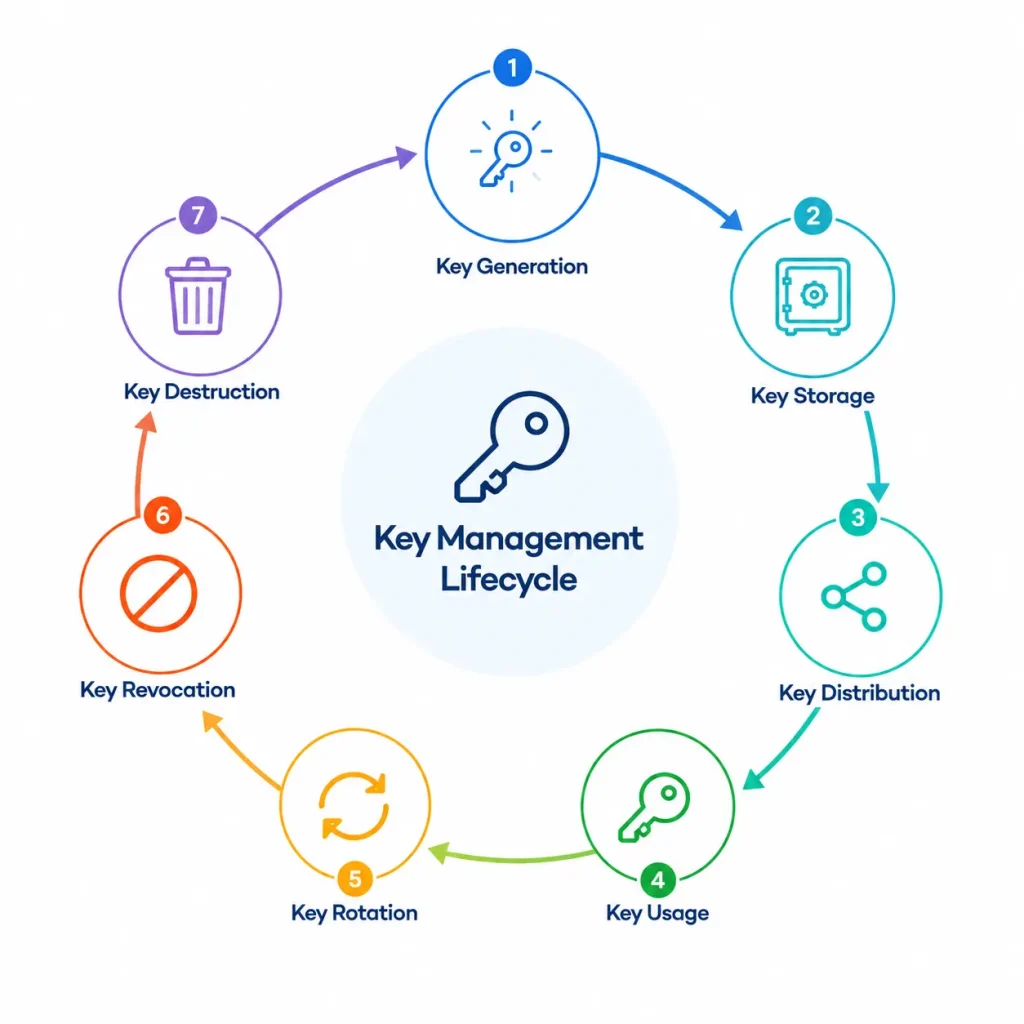
Stages of Key Management Lifecycle
Stage 1: Key Generation
Key generation is the first stage of the key management lifecycle, where a key is generated using strong cryptographic algorithms (AES). The generated key is random to make it unpredictable for attackers to guess. Many IT teams use a key management system or an HSM to securely generate a key.
Stage 2: Key Storage
After the key is generated, we move on to the second stage, which is storing the keys in a secure environment before distributing them to its users. Keys are usually stored directly inside Hardware Security Modules (HSMs), encrypted key vaults, or cloud-based key managers.
Stage 3: Key Distribution
At this stage the keys are distributed to their respective users or systems. This is a very critical stage as keys are moving through different channels, which means there is a possibility that attackers can intercept and steal the keys. Thus, keys should be distributed with extreme caution using secure channels and protocols like TLS.
Stage 4: Key Usage
Keys are now used by users or systems for performing cryptography operations. This involves encryption, decryption, digital signatures, and user authentication. Each of the activities performed by a key is recorded to identify any unusual activity to prevent misuse of the key.
Stage 5: Key Rotation
Old keys over time become vulnerable to attacks. This stage requires replacing (rotating) the old keys with new keys to prevent keys from being exposed or lost. Security teams can use a key management system to regularly update the keys.
Stage 6: Key Revocation
Keys that have been found out to be comprised are now completely turned off. Now, they can no longer be used to perform any cryptographic task. Usually, key revocation takes place before the expiration date of a key.
Stage 7: Destruction
This is the last stage where revoked keys are permanently deleted from existence. All keys are destroyed safely so that no one can recover the key. When a key is destroyed, it becomes unreadable and inaccessible.
Automate Key Management Lifecycle with AppleShineTech
Every stage of the key management lifecycle is very important. Manually tracking each stage can be very complex, time-consuming, and prone to human error, which can increase the risk of keys being compromised.
At AppleShineTech (Thales Implementation Partner), our smart Key Management Solutions can help automate your entire key management lifecycle. Our range of key management systems includes Thales CipherTrust Manager, Thales Luna HSM, Thales payShield 10K, and Thales Cloud Key Management.
You can inquire about these Key Management Solutions via email at info@appleshinetech.com or call us at +91 7042079410.